Meet Eli
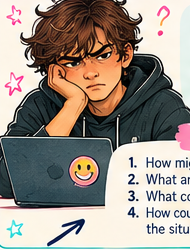
Age 12
💬 “Seriously, Eli?”
💛 A Little About Me
Hey, I'm Eli. I'm 12. People say I'm funny and clever, and I'm loyal — if you're my friend, I've got your back. I'm also good with tech. Spotting patterns, solving problems, coming up with a strategy — that's my zone. I like helping people figure stuff out, too.
At home, it's me, my dad and my younger sister. My dad works long hours, but we're close. I'm the one who teaches my sister how to play games. And after school, online gaming is how I stay connected to my friends.
School is a different story. Getting started on assignments is hard for me, and so is organizing my thoughts. Sometimes I get distracted. Other times I'm just stuck — and too embarrassed to ask for help. Adults have sometimes looked at my unfinished work and decided I wasn't trying.
Gaming is different. My friends like my strategies. They ask me for advice. They count on me as a teammate.
⚡ Something That Happened
It was a really important online match. My whole team was locked in, and everything was going the way I'd planned.
Then my WiFi dropped.
By the time I got back, it was over. We lost.
One of my friends said, "Seriously, Eli?"
Right away, my brain started racing: They think I ruined everything. What if they don't want me around anymore? I finally found somewhere I'm good at something — and now I've let everyone down.
I got mad. But honestly? I was embarrassed, too.
🏫 In Our Classroom
That feeling doesn't only show up when I'm gaming. When something goes wrong at school and somebody sounds annoyed, I can start thinking I'm getting blamed — even before I know what they actually meant.
A thought can feel really convincing. That doesn't make it proof.
🌱 What I'm Learning
I'm working on pausing before I react, and noticing what I'm feeling. Instead of guessing, I can ask, "Wait — what did you mean?"
Maybe my friend was just upset about losing — not upset with me. I'm practicing explaining what happened, like, "My WiFi glitched. It wasn't on purpose." And I'm learning not to treat an assumption like it's a fact.
Appears in: Case #002 · The Blame Game